Agentic AI increases capability
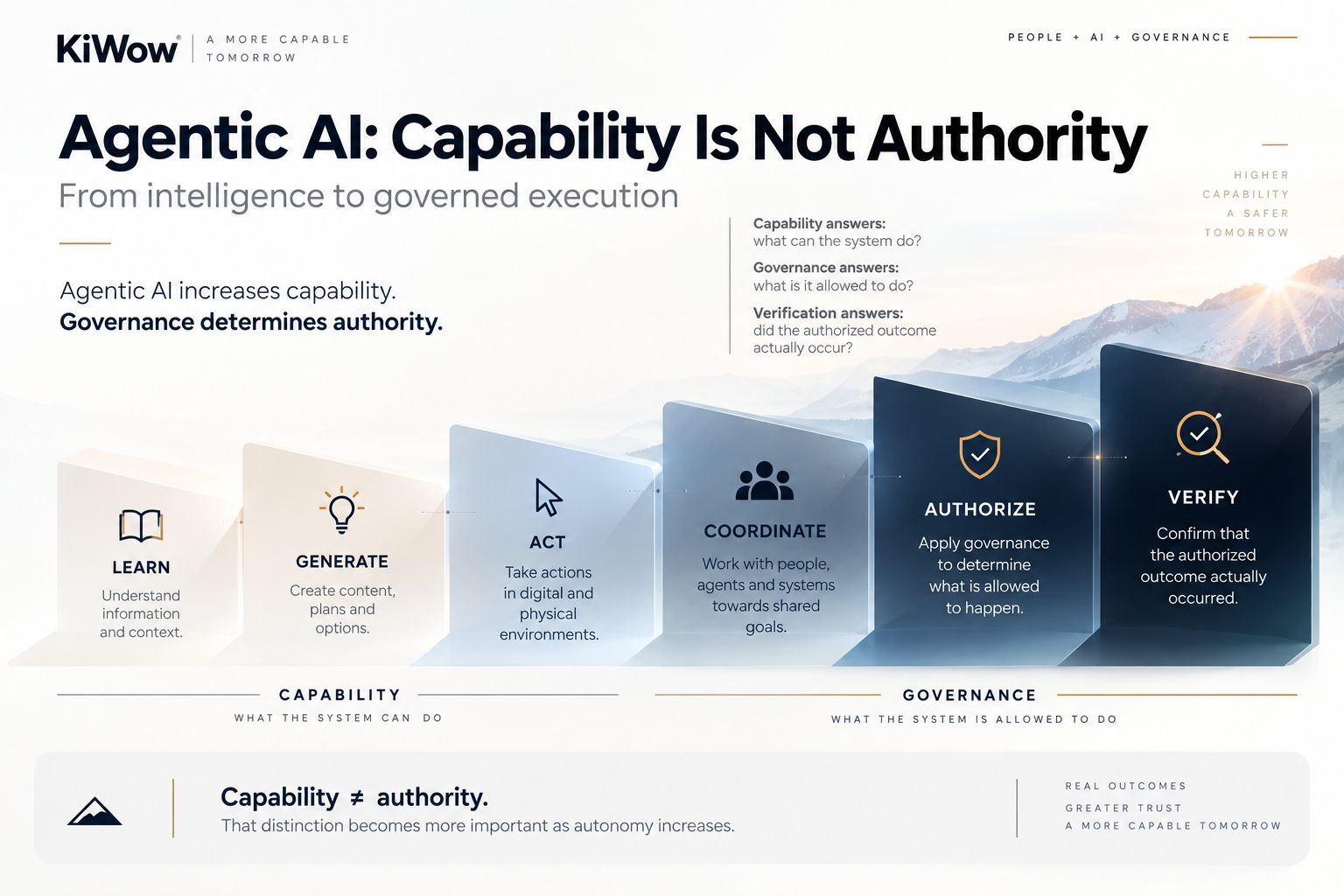
**Agentic AI Increases Capability** As AI systems become able to reason, use tools, coordinate and act, a new question becomes unavoidable: Capability defines what a system can do. Governance defines what it is allowed to do. Verification establishes whether the authorized outcome actually occurred. A concise introduction to one of KeyWow’s core ideas: **Capability ≠ authority.** The goal is not less capable AI, but autonomy connected to legitimate authority and verifiable outcomes.
The conversation around Agentic AI is moving fast.
We talk about models that can reason, generate, use tools, take actions and coordinate with other agents.
But there is a point where increasing capability creates a different question:
Who gave the system the authority to act?
Capability answers:
What can the system do?
Governance answers:
What is the system allowed to do?
And verification asks the question that matters after execution:
Did the authorized outcome actually occur?
These are not the same problem.
As AI moves from generating information to affecting real systems, autonomy alone is not enough.
The next generation of AI infrastructure will need to separate capability from authority — and connect action to governance and verifiable outcomes.
Because a system being able to do something does not mean it should be allowed to do it.
Agentic AI increases capability.
Governance determines authority.
Capability ≠ authority.
Related research
This point of view is developed in more depth in three KeyWow publications:
- What the Hugging Face Incident Teaches Us About Autonomous Execution: a field analysis of why discovering a capability should not automatically grant the authority to use it.
- Beyond Policy-as-Code: Admissibility as a Runtime Primitive for Autonomous Systems: a technical paper on separating capability, permission, authorization and admissibility.
- Pacing the Frontier, Governing Execution: an essay on why more capability should not automatically mean more authority.